Trading plan template: what to put in it, with a filled-in example
A trading plan only helps if you can check yourself against it after every trade. This template has the plan you write once, a daily game plan you fill in before the open, and a finished example so you can see how specific each part has to be. It's a free Word file and opens in Google Docs.

The short version
A trading plan is a short page you can check yourself against: which markets, which hours, which setups, how much risk, and what you do when you hit a limit. Write it once, fill in a game plan before every session, and grade every trade against both. If you can't tell after a trade whether you followed the plan, the plan isn't specific enough yet.
- It's longer than two pages and you never reread it
- Your goals are dollar amounts
- Your setups use words like "strong" or "clean"
- Your limits don't say what you do when you hit them
- Every limit has a number and an action
- Your setups are things you can point at on the chart
- You write a game plan before every session
- You grade every trade against the plan, wins included
Get the template
- Download it from the button above. It's a Word file. In Google Docs use File, Open, Upload.
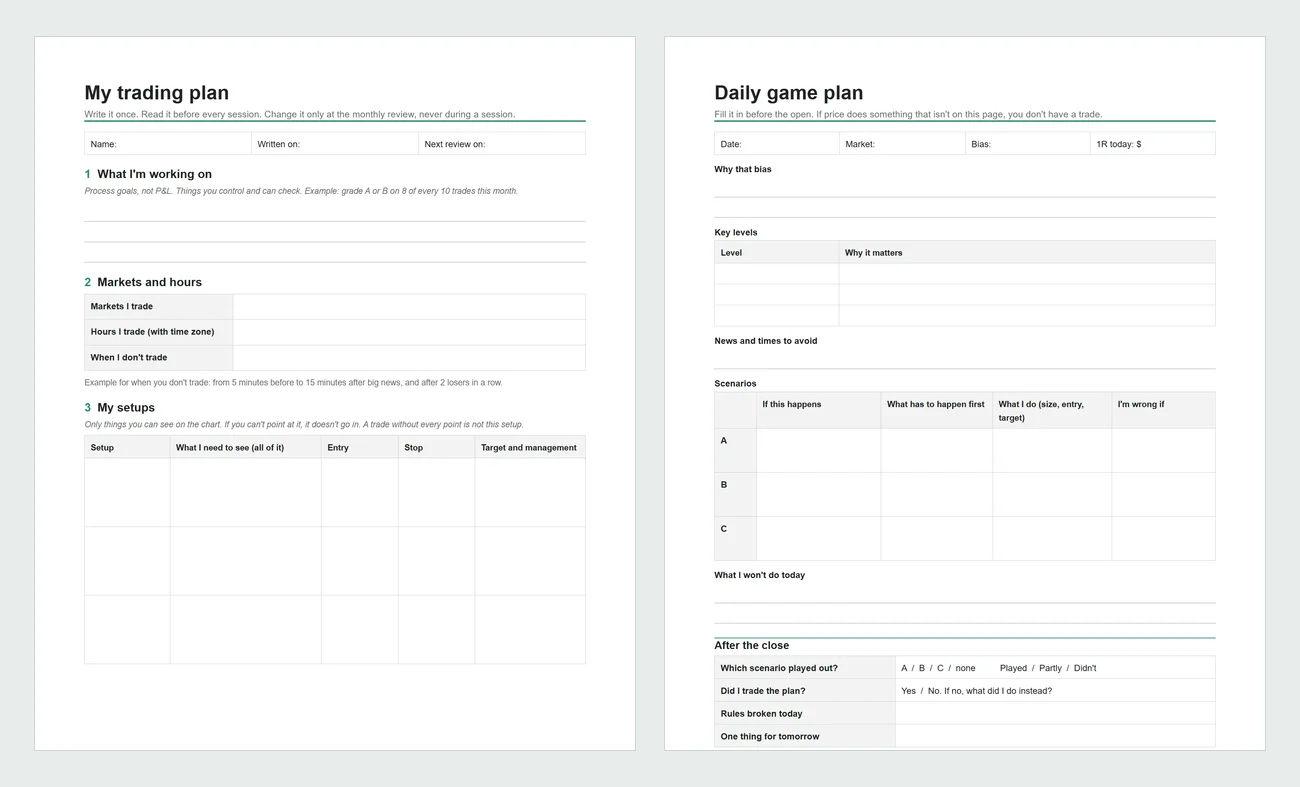
- Pages 1 and 2 are your plan. Fill them in once, then only change them at your monthly review.
- Page 3 is the daily game plan. Print a stack, or copy the page for each day, and fill it in before the open.
- Page 4 is a finished example for an index futures day trader. Read it first, then write your own.
What goes in a trading plan
Seven parts. Each one should be specific enough that after a trade you can say yes or no: did I follow it?
| Part | What to write | Too vague vs specific enough |
|---|---|---|
| What I'm working on | Process goals you control and can check | "Make $5,000 a month" vs "Grade A or B on 8 of every 10 trades" |
| Markets and hours | What you trade, when, in which time zone, and when you don't trade | "The morning" vs "9:30 to 11:30 New York time, never 5 minutes before big news" |
| Setups | What you need to see on the chart, entry, stop, target and how you manage it | "Strong breakout" vs "5-minute close outside the opening range, then a retest that holds one candle" |
| Risk | 1R, max loss per trade, daily and weekly loss limits, max size, max trades | "Keep losses small" vs "1R is $200, daily loss limit $500, then I close the platform" |
| Rules | A short list, each with a number, each kept or broken | "Don't overtrade" vs "Max 3 trades a day" |
| Routine | What you do before the open, during the session and after the close | "Prepare well" vs "Mark levels, fill in the game plan, phone in another room" |
| Review | When you check yourself against the plan, and what you change | "Review sometimes" vs "Grade every trade daily, one fix a week, plan changes once a month" |
The rules part is where most plans go soft. The trading rules guide has 12 examples written so they can't be argued with in the moment.
A filled-in example
This is the example from page 4 of the template. It's made up, for an index futures day trader trading micro Nasdaq futures (MNQ). Your numbers will be different. The point is how specific it is.
| Part | Example |
|---|---|
| What I'm working on | Grade A or B on at least 8 of every 10 trades. 10 sessions in a row with no rule broken. Game plan filled in before every session. |
| Markets and hours | NQ, traded with MNQ. Nothing else. 9:30 to 11:30 New York time. No trades from 5 minutes before to 15 minutes after CPI, the jobs report or FOMC. |
| Setup | Opening range break and retest: the first 15 minutes set a range, a 5-minute candle closes outside it, price comes back to the edge and holds it for one full candle. Entry on that candle's close, stop back inside the range (25 points at most), target 2R, stop to break-even at 1R. |
| Risk | 1R is $200: 4 MNQ with a 25-point stop is 4 × 25 × $2. Daily loss limit $500, then close the platform. Weekly loss limit $1,200, then done until Monday. Never more than 4 MNQ. |
| Rules | Max 3 trades a day. Stop after 2 losers in a row. Never move a stop further away. |
| Routine | Before: read the plan, mark levels, fill in the game plan. During: only trades on the game plan, one line written after each. After: import, grade, tag mistakes, close out the game plan. |
| Review | Every day grade each trade A to F on how well it followed the plan. Every week the most expensive mistake becomes the only focus. Every month change one thing in the plan at most. |
Notice there are no dollar goals. A trader who follows this plan for a month knows exactly what worked, whatever the P&L says. A trader who aims for "$5,000 this month" sizes up on the first red week.
Writing the risk part for your market
Write 1R in dollars, then work out the size that risks it with your normal stop. The maths is different for each market, so here's what a $200 risk looks like in each:
| Market | How the risk works out | 1R of $200 |
|---|---|---|
| Micro Nasdaq futures (MNQ) | Contracts × stop in points × $2 a point | 4 contracts × 25 points × $2 |
| E-mini S&P 500 (ES) | Contracts × stop in points × $50 a point | 1 contract × 4 points × $50 |
| EURUSD | Lots × stop in pips × $10 a pip per standard lot | 1 lot × 20 pips × $10 |
| Gold (XAUUSD) | Lots × stop in dollars × 100 ounces a lot | 0.5 lots × $4 × 100 |
| Stocks | Shares × stop in dollars | 400 shares × $0.50 |
| Stock options | Contracts × stop in option price × 100 | 2 contracts × $1.00 × 100 |
The position size calculator does this for any market. For the per-tick and per-pip values there's a futures tick value calculator, a pip calculator and a gold pip calculator.
Then write the daily loss limit as a number of R, so it still makes sense when you change size. Two to three R is a common place to start. Whatever you pick, write what you do when you hit it: "close the platform" is a rule, "be careful" isn't.
The daily game plan: the part most templates skip
The plan says how you trade. The game plan says what you're waiting for today. Most traders skip it, and then every move during the session looks like a setup. If price does something that isn't on today's page, you don't have a trade.
Write two or three scenarios as "if this, then that", each with where you're wrong. An example for the plan above, with made-up levels:
| If this happens | What I do | I'm wrong if | |
|---|---|---|---|
| A | A 5-minute close above the overnight high at 31,460, then a retest that holds | Long 4 MNQ on the retest, stop 31,435, target 31,510 (2R) | It closes back below 31,460 |
| B | A 5-minute close below 31,400, then a retest from below that fails | Short 4 MNQ on the failed retest, stop 31,425, target 31,350 (2R) | It reclaims 31,400 and holds a full candle |
| C | Still chopping between 31,400 and 31,460 at 10:30 | Nothing. Wait for A or B until 11:30, then done | Not a trade, so nothing to be wrong about |
Add the news times you won't trade through and one line on what you won't do today, like "no shorts into the overnight low". After the close, mark which scenario played out (played, partly, or didn't) and whether you traded the plan. Over a few weeks that tells you something the P&L can't: whether your reads are good, and whether you act on them.
Why most trading plans get ignored
- Too long. If you can't read it in two minutes before the open, you won't.
- Dollar goals. They push you to size up after losses, which is the opposite of the plan.
- Setups you can't point at. "Strong momentum" means whatever you want it to mean at 10:14 with your heart rate up.
- Limits without an action. "Daily loss limit $500" leaves the next step open. "Daily loss limit $500, then I close the platform" doesn't.
- Changed after every bad day. A plan you rewrite after losses stops meaning anything. Change it once a month, one thing at a time.
- Never checked. Nobody compares the trades against the plan, so breaking it costs nothing you can see.
How to tell if you're actually following it
After every session, go through each trade and ask one question: did this trade follow the plan? Grade it A to F on that, not on the P&L. A losing trade that followed every point is an A. A winner you took outside your hours is an F. Then put a dollar number on the breaks: "4 trades outside my hours this month, -$1,140" is what finally changes behaviour.
That's the part I built Actal for. You set your risk rules once and every trade you import from your platform is checked against them, with what each break cost. The premarket plan has A, B and C scenarios for each market and gets closed out after the session, and "traded the plan" becomes a weekly number next to your grades. It's free while in beta. If you'd rather stay on paper, the trading journal template works with this plan too, and the trading checklist is the short version of it to keep next to your screen.
When it helps to have someone look at it
Writing the plan is the easy part. Seeing why you keep stepping outside it is usually easier from the outside. The money side, sizing and loss limits, has its own risk management guide on the academy site. If you're not sure which part of your trading to fix first, the free trading diagnostic asks 31 questions across seven areas and names the one to start with.
Who wrote this
I'm Joakim. I trade index futures full time and coach traders one-on-one at Jusell Trading Academy. I built Actal too, so weigh that, but the template is free and stays free.
Questions people ask
Drop in one export. In a minute Actal grades the trades it can, prices the mistakes you tagged, and tells you the first thing to fix. Free during beta, no card.

Full-time index futures trader. Coaches traders one-on-one at Jusell Trading Academy, five students at a time, since 2020. No platform was built for developing traders, so he had his own coaching software built; old students loved it and kept coming back, and Actal is that software turned into a proper journal for what matters.