Notion trading journal template (free): P&L, R and what each mistake costs
A free Notion trading journal you copy in one click. Log a trade and P&L, risk and R fill in by themselves. Grade it on how well you followed your plan, tag the mistake, and the Mistakes view adds up what each one has cost you. It works for futures, forex, stocks, options and crypto.

The short version
Duplicate the template, set $ per point once for each market you trade, and log every trade the same day. The Mistakes view tells you which mistake to fix first. When typing trades gets old, Actal does the same from your platform's export file, free during beta.
- You already keep your notes and trading plan in Notion
- You take a few trades a day
- You want your journal, playbook and reviews in one place
- You like changing properties and views yourself
- You'd rather import trades than type them
- You want every trade checked against your rules automatically
- You want your stats after a loss, by trade number of the day and by size
- You want mistakes caught even on the days you don't tag them
Get it into your Notion in a minute
- Open the template from the button above.
- Click Duplicate at the top right and pick your workspace. It needs a free Notion account.
- Change the four lines under the title to your own account size, risk per trade, daily loss limit and max trades a day.
- Rename the setups and mistakes to your own: click any tag in the table and edit the options.
- Look through the example week, then delete the example trades, days and week and start with your own.
What's in the template
| Part | What it does |
|---|---|
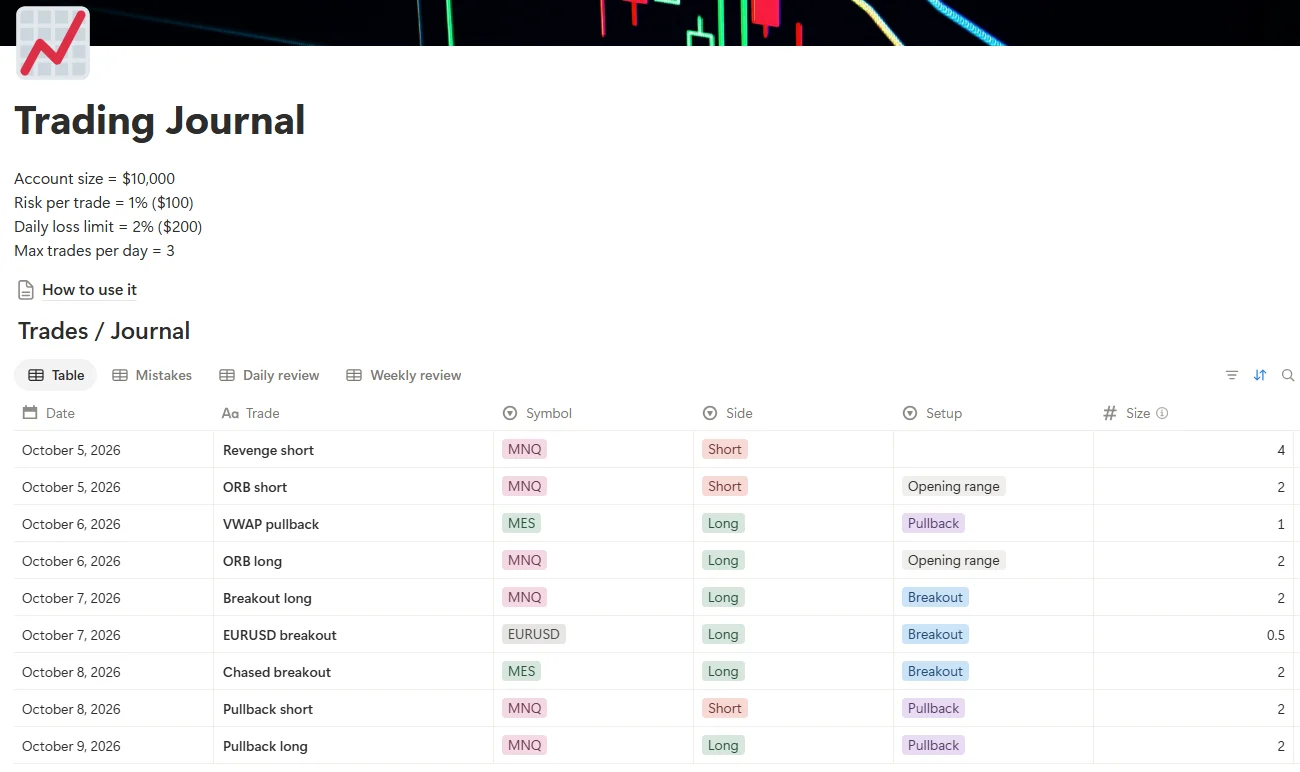
| Table | One row per trade. Enter date, entry, exit, stop, size, $ per point and fees, and P&L, risk in dollars and R work out by themselves. Add the setup, a grade from A to F, whether you followed your plan and the mistake if there was one. |
| Mistakes | Only the trades with a mistake, grouped by mistake, with a total cost for each. The biggest total is next week's fix. |
| Daily review | One row a day: the plan before the open, whether you kept it, the lesson and the fix for tomorrow. |
| Weekly review | One row a week: the week's P&L next to what mistakes cost, the most expensive mistake and next week's one fix. |
| How to use it | The five steps, and the $ per point for every market. |
The grade is about process, not money. An A is a trade you took exactly as planned, even if it lost. That's why the example week has an A-grade loss in it.
Setting $ per point for your market
$ per point is the dollars a 1.0 price move makes on 1 unit of size. The template does the rest: price move times size times $ per point, minus fees. Set it right once and every market works the same way.
| Market | Size is | $ per point |
|---|---|---|
| Micro futures: MNQ, MES, M2K, MYM | Contracts | 2, 5, 5, 0.50 |
| E-mini futures: NQ, ES, RTY, YM | Contracts | 20, 50, 50, 5 |
| Crude oil (CL), gold (GC) | Contracts | 1,000 and 100 |
| Stocks and ETFs | Shares | 1 |
| Options | Contracts, with the premium as the price | 100 |
| Forex pairs ending in USD: EURUSD, GBPUSD, AUDUSD | Lots (0.1 is a mini lot) | 100,000 |
| Forex pairs starting with USD: USDJPY, USDCAD | Lots | 100,000 divided by the price (USDJPY at 150: about 667) |
| Gold CFD (XAUUSD) | Lots | Usually 100, check your broker's contract size |
| Crypto | Coins | 1 |
An example from the template: EURUSD long, 0.5 lots, in at 1.1650 and out at 1.1680, with $3.50 in fees. 0.0030 times 0.5 times 100,000 is $150, so $146.50 after fees. The stop was at 1.1635, so the risk was $75 and the trade made 1.95R.
What the example week shows
The template comes with a made-up week of nine trades so you can see it working. The week made $315.42. The mistakes in it cost $357.44:
- A revenge trade at double size, three minutes after a clean stop: $204.96.
- Two winners cut early, 10 points before the target each time: $80.
- A stop moved twice: $42.48 more than the planned loss.
- An entry chased 3 points above the plan: $30.
So the mistakes cost more than the week made. That's the point of a journal: P&L tells you how the week went, the mistake column tells you what to change. Here it's one rule, wait 15 minutes after any loss, and in this week that rule alone would have saved $205.
Where a Notion journal runs out
- Typing every trade. Five trades a day is 25 rows a week, and the days you skip are usually the bad ones.
- You price your own mistakes. The template adds up the cost you type in, but a mistake you don't tag never shows up.
- It can't check your rules. A daily loss limit in Notion only works if you look.
- Win rate by setup, expectancy and stats after a loss mean building your own formulas and views.
That's what Actal is for: it reads your platform's export, checks every trade against your rules, and shows where the money goes, including after a loss, by trade number of the day and by size. It's free during beta. Or stay with Notion; it beats no journal at all. If you'd rather work in a spreadsheet, there's a free Excel and Google Sheets template too.
Who wrote this
I'm Joakim. I trade index futures full time and coach traders at Jusell Trading Academy. The template follows the way I go through a student's week: grade first, P&L second, and one mistake to fix at a time. I built Actal too, so weigh that, but the template is free and stays free.
Questions people ask
Drop in one export. In a minute Actal grades the trades it can, prices the mistakes you tagged, and tells you the first thing to fix. Free during beta, no card.

Full-time index futures trader. Coaches traders one-on-one at Jusell Trading Academy, five students at a time, since 2020. No platform was built for developing traders, so he had his own coaching software built; old students loved it and kept coming back, and Actal is that software turned into a proper journal for what matters.